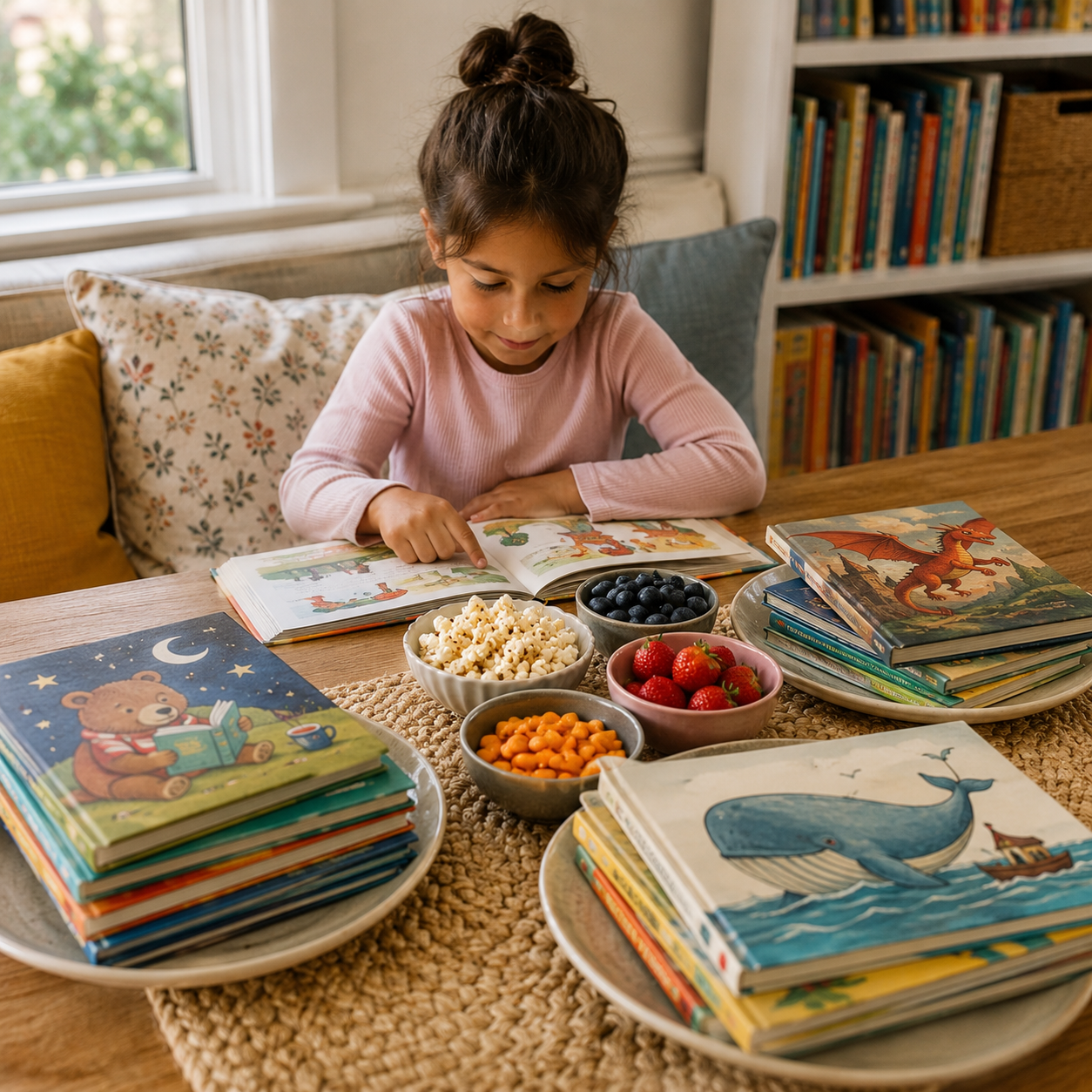
If Books Were Snacks: What Kids Would Actually “Crave” to Read
Think about the way kids approach food.
Some have a favorite meal they would happily eat every week. Others are always eager to try something new. And some need a little time before they warm up to something unfamiliar. They might watch someone else enjoy it, see it a few times, or hear a friend rave about it before deciding to give it a try themselves.
Reading preferences can develop in much the same way.
One child might become completely hooked on a funny series. Another might return to the same favorite book again and again. Another might suddenly become interested in reading because they found a book about dinosaurs, soccer, space, or a topic they already love.
Sometimes, a book simply needs the right introduction. Seeing classmates excited about a series, spotting an interesting cover on a classroom shelf, or hearing someone talk enthusiastically about a book can be enough to make a child curious. This is part of the Community Reading Effect, where shared excitement around books can spark curiosity and encourage other children to join in.
Promoting a love of reading isn't about getting every child excited about the same books. It's about giving children enough exposure to discover the kinds of reading experiences that make them want to come back for more.
Like food, reading is personal. And when kids are surrounded by an appealing variety of books, they're more likely to discover something they crave.
Why Do Some Books Feel More “Appetizing” Than Others?
There isn't one type of book that appeals to every young reader. But there are a few things that can make a book feel more inviting.
Familiarity makes books approachable. A book that reminds children of something they've enjoyed before can feel easier to pick up. Maybe it's another book in a familiar series, a recognizable character, or a topic they already know something about. Familiarity gives young readers an easy place to start.
Interest keeps kids engaged. Children are more likely to stay with a book when something about it captures their attention. That might be the subject, the humor, the characters, the illustrations, or simply a question they want answered. Interest gives children a reason to keep turning pages.
Small successes build an appetite for more. Finishing an enjoyable book can give a child a sense of accomplishment. That positive experience makes the next book feel a little more approachable. Over time, those small successes can build confidence and help reading become something children look forward to.
Every reader needs a good starting point. Some children are ready to dive into longer books, while others connect more easily with shorter stories, familiar series, illustrated texts, or books centered around topics they already enjoy. The goal isn't to rush children toward the most challenging book on the shelf. It's to help them keep reading and gradually build the confidence and skills to explore more.
For a closer look at why consistent reading experiences matter, explore our blog, Why Reading Habits Matter More Than Reading Levels.
What's Your Child's “Reading Taste”?
Reading preferences rarely fit into one neat category. A child might be a comfort reader one week and an adventurous reader the next. But thinking about the kinds of books children naturally gravitate toward can help parents and educators understand what keeps them engaged.
The Comfort Food Reader
These readers return to familiar favorites again and again. They know the characters. They remember what happens next. They might even be able to recite parts from memory.
That repetition isn't necessarily a sign that they're stuck. Research shows that revisiting familiar texts can help children strengthen fluency and deepen comprehension while becoming more confident readers.
Sometimes the book they already love is exactly what they need.
The Dessert First Reader
These readers want books that hook them quickly.
They love humor, action, surprising facts, exciting mysteries, and stories that give them an immediate reason to keep going. A slow beginning may lose them, but give them something that makes them laugh or wonder what happens next and they're ready for another bite.
For these readers, a high-interest book can be the spark that turns reading into something they genuinely look forward to.
The Seconds, Please Reader
These readers love discovering new worlds, characters, and ideas.
They may become absorbed in fantasy adventures, mysteries, historical settings, or an entire series that gives them somewhere new to explore. Once something captures their imagination, one book can quickly turn into two, three, or an entire shelf.
Their reading appetite is fueled by discovery.
The Feast-for-the-Eyes Reader
For these readers, how a book looks is part of the experience.
They may gravitate toward graphic novels, illustrated stories, comics, or books where visuals play an important role in communicating information. Images don't replace reading. They work alongside text to help readers interpret characters, action, emotion, and meaning.
Research into graphic novels has found that combining visual and textual information can support reading comprehension, making these formats a meaningful part of a young reader's literary diet.
The Reluctant Sampler
Some children need a little more time before they're ready to dig in.
They may walk past the bookshelf without stopping or insist that they simply don't like reading. But that doesn't necessarily mean books aren't for them. They may need more exposure to different topics, formats, and reading experiences before something clicks.
The goal isn't to force a full plate. It's to keep offering inviting opportunities to discover something that sparks their curiosity.
Access Matters: Kids Can't Crave Books They Never Encounter
A child can't develop broad reading interests without opportunities to encounter different kinds of books.
That's why access to books and variety go hand in hand.
Classrooms, school libraries, public libraries, and home bookshelves can introduce children to subjects, characters, genres, and formats they may never have encountered before. The more varied those experiences are, the greater the opportunity for a child to find something that connects.
And access matters beyond simply discovering favorites.
Research consistently connects reading enjoyment with stronger reading habits and skills. The National Literacy Trust's large-scale research found that children and young people who enjoyed reading had significantly higher average reading scores than those who didn't enjoy it. Children who read daily also had significantly higher scores than those who didn't.
In other words, finding books children enjoy can help create a powerful cycle:
Access creates exposure. Exposure creates opportunities for connection. Positive connections encourage more reading. And more reading creates opportunities for growth.
That's one reason access to books matters so much when schools and families are working to promote a love of reading.
For a deeper look at this connection, read How Access to Books Shapes Early Literacy Success and Reading Motivation.
From “I Like This Book” to “I'm a Reader”
Finding a book a child enjoys may seem like a small moment.
But reading appetites can grow one good experience at a time. One book they love makes them hungry for another, and before long, those individual favorites can begin adding up to something bigger.
A child finishes a funny book and looks for another. A familiar series becomes something they look forward to. A fascinating nonfiction book leads them to search for another one about the same subject.
Eventually, reading can begin to feel less like something they're supposed to do and more like something that belongs to them.
That's where reading identity begins to take shape.
That identity shift is powerful. A child who says, “I am a reader” carries that belief with them into every grade, every library visit, and every summer break.
Research on children's reading consistently shows a relationship between reading enjoyment and reading frequency. When children enjoy reading, they're more likely to return to it, creating more opportunities to strengthen their skills and confidence over time.
And right now, helping children develop that connection with reading matters. The National Literacy Trust's 2026 research found that just over one-third of children and young people ages 8 to 18 said they enjoyed reading in their free time.
Promoting a love of reading starts with giving children more opportunities to experience what makes reading worth returning to.
Programs like Book Blast help extend access to books beyond the classroom by putting new, age- and grade-appropriate books directly into students' hands. Every student receives at least one new book to keep at no cost to the school or families, helping children build home libraries and giving them more opportunities to read outside of school.
Because when books make their way home, reading doesn't stop at the classroom door.
It continues on the couch, in the car, before bed, and under the covers with a flashlight.


.png)